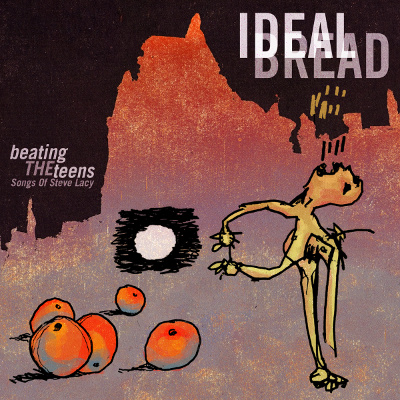
IDEAL BREAD Beating the Teens : Songs of Steve Lacy
Description
With Beating the Teens, Ideal Bread's leader and baritone saxist Josh Sinton, who studied with Steve Lacy during the last years of the soprano sax master's life, decided to radically question and deconstruct the notion of a repertory band. Since the release of their first album in 2007, the group has existed with only two rules: 1.) Ideal Bread would be a band in the traditional sense, with the same members for every album and every show 2.) Ideal Bread would play exclusively the music of iconoclastic saxophonist-composer Steve Lacy.
And with this album, Ideal Bread continue to uphold these rules, but with a change of emphasis. As Sinton puts it, 'In the beginning we were a Steve Lacy-repertory band that happened to be composed of four gifted improvisers, but along the way we've become a band of four gifted improvisers who happen to play the music of Steve Lacy. And the new album had to reflect that shift.'
Acting on this, Sinton set out laying the groundwork for this new work. Using his concept of the musical object as a 'flexible container' for the performer's ideas and personalities, he looked around for a container large enough to hold all the idiosyncrasies and facets of his longtime band-mates Kirk Knuffke (cornet) and Tomas Fujiwara (drums) as well as their newfound member Adam Hopkins (bass).
He found what he was looking for in Scratching the Seventies/Dreams, the 3-CD box set that collects all five LP's Steve Lacy recorded for the Saravah label from 1971 – 1977. In these recordings, some of the earliest of Lacy's compositions and therefore almost embryonic, Sinton found, 'There was enough room for us to be ourselves in this music.'
This has led to an album that unselfconsciously embraces the sounds of Iggy Pop, musique concrète, Mos Def, Art Ensemble of Chicago, Morphine, 17th-century Baroque and Brooklyn's current creative music scene among many others. 'I kept each new arrangement only if I could affirmatively answer the question, 'Is this who we are?' ' says Sinton. Beating the Teens is a record that could only be made by young improvisers in the 21st century, representing as it does the conflation of sounds and influences that is a trademark of this generation of artists. On it, Ideal Bread adhere to and respect Lacy's unique compositional vision, while giving them an original approach and a new life.
Titles
CD One
01. Three Pieces From Tao – I
02. Obituary
03. The Precipitation Suite [I Feel a Draft/Cloudy/Rain]
04. Wish
05. Lesson
06. The Wire
07. Paris Rip-off
08. Cryptosphere(s)
09. Scraps
10. The Highway
11. The Wane
12. Dreams
13. Somebody Special
14. Name
15. Three Pieces from Tao – II
CD Two
01. Three Pieces from Tao – III
02. The Owl
03. Spell
04. Crops
05. Pearl Street
06. Ladies
07. Blinks
08. Cryptosphere
09. Lapis
10. The Uh Uh Uh
11. Torments
12. The Oil
13. Notre Vie
14. Roba
15. Three Pieces from Tao - IV
Press
Kwadratuur (NL · Joachim Ceulemans · 02/06/2014)
Crowdfunding afdoen als een randverschijnsel is de realiteit ontkennen. Tegenwoordig worden op elke hoek fans of sympathisanten geronseld om projecten van het benodigde startkapitaal te voorzien, van kleine commerciële ondernemingen en sociale projecten tot in het voetbalwezen en de jazzmuziek. Ideal Bread, het kwartet van baritonsaxofonist Josh Sinton dat zich uitsluitend op het oeuvre van Steve Lacy toelegt, haalde via de crowdfundingwebsite Kickstarter meer dan 8000 dollar op om 'Beating The Teens', het derde album van de groep, te financieren. Die investeerders worden nu bedankt voor hun vertrouwen met een beresterke dubbelaar.
Conceptueel verschilt ‘Beating The Teens’ met de vorige twee platen (‘The Ideal Bread’ en ‘Transmit’) in die zin dat het kwartet de stukken van Lacy niet langer simpelweg speelt of interpreteert. Sinton wilde meer creatieve inbreng van zichzelf en van de groep en ging daarom op zoek naar het Lacy-repertoire dat het meest kneedbaar is. Zo kwam hij uit bij enkele albums die de sopraansaxofonist in de jaren zeventig voor het Saravah-label maakte en die later met de cd-box ‘Scratching The Seventies/Dreams’ werden gebundeld. Hij ging met dit materiaal aan de slag, schreef aangepaste of nieuwe arrangementen en liet daarbij veel ruimte voor de improvisatorische inbreng van Kirk Knuffke (cornet), Adam Hopkins (bas) en Tomas Fujiwara (drums).
Die aanpak resulteerde in dertig relatief korte tracks, met daarin een opmerkelijke afwisseling en een karrenvracht aan invloeden. Zo spreekt Sinton in de promotekst over een lange lijst met onder meer Fugazi, Iggy Pop, Tim Berne, Henry Threadgill en Mos Def, wat meteen verklaart waarom Ideal Bread op dit dubbelalbum alle kanten opstuitert. In 'Wish' doet het kwartet denken aan een rockband, maar dan wel in een wereld waar Henry Cow als de standaard voor die categorie geldt: strak en groovy, maar tegelijk ook onvoorspelbaar, gevaarlijk en met een serieuze hoek af. De baritonsax van Sinton wordt hier ritmisch mooi uitgespeeld tegen de bas van Hopkins, iets waar Knuffke met een uiterst sappige solo van profiteert. Eenzelfde ritmische fixatie is terug te vinden in 'Scraps', waar Sinton zich op zijn beurt solistisch uitleeft bovenop het druk hotsende werk van de ritmesectie.
Slechts enkele tracks vallen min of meer onder de noemer "traditionele jazz". In 'Obituary' en 'The Owl' worden de typische jazzstrategieën vooral gebruikt om de composities op een groteske manier uit te vergroten. 'Crops' is daarvan zowat de tegenhanger. Het kwartet ontdoet de muziek hier van alle complexiteit en legt de zoete charme van een eenvoudige muzikale constructie bloot. Op andere momenten kiest het kwartet louter voor wat sfeer en ongein. 'Cryptosphere(s)' en 'Cryptosphere' worden gekleurd door piepende, kreunende en ritselende geluiden terwijl ver op de achtergrond een opname van het kwartet lijkt te worden afgespeeld. Muzikaal heeft het dan wel weinig waarde, qua zelfrelativering kan het absoluut tellen.
Verrassend is het brutale geluid dat de groep soms laat horen. 'The Oil' is een bundeling van muzikale uppercuts, dankzij punky elektrische baslijnen en gebroken ritmes die samen telkens een punch van jewelste veroorzaken. Ook laat Sinton zijn bariton geregeld briesen en knorren in onder meer 'The Wire' en 'Lapis', waar het speeksel bijna voelbaar in het rond vliegt. Zulk geweld heeft de groep nooit eerder gebruikt, maar het staat haar wel, net zoals al de rest van de muzikale potpourri die ‘Beating The Teens’ in zijn totaliteit is.