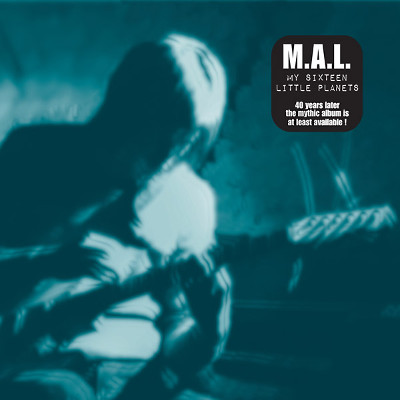
Description
40 years later the mythic album is at least available !
Lies of omission and appropriations.
The story of a magnetic tape that contained a trade secret.
Four decades after its release (on Orh, 1975), Inventions for Electric
Guitar, the solo debut by Ash Ra Temple guitarist Manuel Göttsching,
is now a classic, an undisputed worldwide reference. This album was
made using only an electric guitar and a simple 4-track tape recorder.
So was the challenge, and so was its impact. Göttsching recorded it in July-August 1974 in Berlin, after a sudden technical revelation. The
original LP sleeve had the following printed on its back: Manuel
Göttsching (guitars only). Manuel played his guitar and used a 4 track
TEAC A3340, Revox A77 for echoes, WahWah pedal, volume pedal, Sola
Sound Fuzz, Schaller Rotosound and Hawaiian steel bar.
The reaction was unanimous: this was a significant innovation,
in terms of both technique and creativity.
However, there are little-known facts to this case. In early 1974,
Göttsching's label received a tape sent by M.A.L. - same design, same configuration, almost the same tracks. This is known by only a handful
of experimental musicians from the Charleroi area. M.A.L. aka Daniel
Malempré is the actual inventor of this technique, which Göttsching
reproduced a few months later. Given the above, I suggest that we listen
to both albums. As doubts are removed, the truth sets in, forty years later. Here's hoping that this will ease the deep disgust that made M.A.L. leave
his guitar untouched for so long.
All music by M.A.L. / Fender Stratocaster 1964, pedal Wah-Wah Cry Baby. / Recorded and mixed at home between 1972 and 1976 on a reel to reel recorder Sony TC-630.
Titles
01. Deimos 8.54
02. Betelgeuse 2.56
03. Mira 3.02
04. Elara 7.14
05. Thor 9.40
06. Thethys 6.35
07. Phobos 2.09
08. Erinome 3.46
Press
Vital Weekly (EN · FDW · 06/11/2018)
This bunch didn't arrive on the same day, so in the past weeks I have been hearing these in various
combinations. I was thinking where to start the review and decided to start with the closest outsider
of the Insane Music family and that is M.A.L. Daniel Malempre, as his real name is, is one of the
main musical collaborators of Alain Neffe, the man behind Insane Music, once a cassette label and
a family of bands and projects, most of which are subject of this review. Malempre was the guitarist
of Kosmose, more about that later, of Human Flesh and Subject. Very early on, somewhere in the
mid 80s probably, I already heard the story of a demo he send in the mid 70s of his solo guitar and
reel-to-reel compositions, which concept was 'stolen' by Manuel Göttsching on his 'Inventions For
Electric Guitar' and since then I was always curious to hear M.A.L.'s own music. There has not been
a lot of that, but EE Tapes released 'Eighties' (see Vital Weekly 585) which included pieces he
recorded in those years, but this new CD contains his 1972 to 1976 recordings. The cover tells you
the technical side of the story, about one guitar and a four-track recorder, bouncing of tracks and
recording at higher/slower speeds. And of course I too went to the Göttsching 1975 record (look for
it on YouTube) to compare both albums. It is not difficult to hear that both tap out of the same book
of ideas; guitars, lots of delays and both are cosmic trip. I am not the sort of guy that can rightfully
say if Göttsching stole the idea for this from Malempre, or simply was simultaneously developing
his own brand of working with reel-to-reel recorders. As did Brian Eno and Robert Fripp at the same
time; all building on working with reel-to-reel machines like musique concrete composers did since
the fifties. M.A.L. has sixteen pieces here and range from a minute miniature to over fifteen minutes.
There is indeed a lot of music on this release, seventy-seven minutes and not all tracks are equally
great, but you get a very good idea of how M.A.L. worked. It works best if he keeps his drones and
loops together, spice with some bass notes and a small, repeating melody or phrase, as in
'Cassiopee' or 'Betelgeuse'. Sometimes a song is merely an idea and that's it, but then it doesn't
work that well, especially when it is a long piece, such as in 'Thor'. I am not deciding the fight over
originality here. I enjoyed hearing these pieces after all the rumour for all these years and all
Göttsching fans should hear this too and make up their own minds.
Malempre was together with Alain Neffe part of Kosmose in the seventies and up until a few
years ago I never knew that Neffe did any music before 1979/1980 when he surfaced with Pseudo
Code. Back then, when I first heard his music, I knew that I Scream was a solo project with some
older recordings, but I didn't think he would be part of a band. Sub Rosa released a double CD by
them some years ago and that was the first time I heard about it. That one wasn't reviewed, but EE
Tapes did one as well (see Vital Weekly 1111) and the archives of Kosmose are delved into further
with this double release (and I happen to know there is more in case someone is interested). Here
Kosmose is Neffe on monophonic synthesizer, flute, primitive rhythm box, cymbal, bell, clumpsy
voice, tarang, Malempre on electric guitar, 112 string acoustic guitar and Francis Pourcel on bass,
bass with violin bow, electric guitar. Kosmose went through various stages with differing line-ups
and this is the first version and contains a recording of their only concert. The absence of a
drummer makes them even more spacier, more kosmische than on the previous recordings I heard
from them. Malempre's guitar sounds at times like it does sound like the work on his solo CD. I quite
enjoyed those previous releases, but they reach for a sound here that I like even more. It is hippie
trippy music of course, vast and spacious, free and wild, but it is very much away from the beat
driven krautrock that was also part of the scene and of which Kosmose also had a bit. But these live
recordings, recorded with two microphones and reel-to-reel deck ("recorded by Alain while playing"
says the cover; bravo!), makes that this is also a bit of rough diamond and it exactly that roughness
that I like very much. There is nothing polished about this music and we are witnessing an all out
space jam. Close your eyes and float away; play loud and you could believe you are right there
and then, present in the audience. No incense required but it could help (I wouldn't know; I dislike
incense). One hundred minutes of pure bliss,
The '4 in 1' series are a sort of progress report/archive of Insane Music bands, but also allowes
outsiders into the family. The first one is a legendary cassette from the early 80s, followed by a LP a
little later. Volume 3 (CD; see Vital Weekly 846) and 4 (cassette; see Vital Weekly 1043) are more
recent and now there is a volume 5, again on LP, with three Alain Neffe projects and M.A.L. is also
present. There is a CD version included with bonus tracks for all four projects, one for each. The
archival function is for the pieces by I Scream (1975) and Human Flesh ("late 80s-early 90s")
whereas from Bene Gesserit and M.A.L. the pieces were recorded in recent years. Those two
projects are on the first side, with four Bene Gesserit pieces that display their Dadaist version of
electronic music in a very fine way. The voices are fed through a vocoder in 'Ceci N'est Pas Une
Chanson...', or with Benedict G singing mysteriously in 'Les Fourmis', or the all out fun (?) of 'Half
Hyserical Mid Tempo Sort Of Rock', being a very classic and funny Bene Gesserit piece. M.A.L.
has expanded his old style with drum machines and synthesizers and his music has a fuller flavour
now. A bit orchestral in 'Trinity Will Kill Again', Middle Eastern inspired in 'Turkish Morning' or raga
in 'Indian Song', all of which come with M.A.L.'s trademark guitar loops. Human Flesh here is in full
collaborative modus here, with people supplying sounds on tape and Neffe adding his music and
sounds to it. Some of these pieces are with M.A.L. or Xavier S of Pseudo Code but also words
supplied by Lena Torgrimsen. Human Flesh is always a bit moody and atmospheric, with string
like drones and loops of saxophones, flutes and guitars and with these pieces reach for a more
poetic approach, not unlike Cortex, even if that was more minimal. I Scream remain one of the
more obscure Neffe projects, his earliest solo music from the mid 70s. Here he experiments with
old synthesizers and reel to reel machines, rhythm machines and "Elka strings" and the music is
the most experimental of the whole record, with weird synthesizer sounds, especially on the CD
bonus track '(Maybe) I'm Slowly Going Insane', but also cosmic in 'Saved By The Synth'. Hearing
this I think it should be about time there is a double CD with all of these early I Scream pieces.
Excellent compilation and with only four bands one has a clearer idea of what they are about
should you be a novice to this music.
And then Pseudo Code. I can't reveal my personal hierarchy in liking bands from Insane
Music, but I can tell you that Pseudo Code is my favourite band. It is, perhaps, also the first I really
heard and read about; no doubt in a fanzine called 'BoH' and a Dutch music magazine 'Vinyl'.
Early on I picked up their second 7" 'Moon Effect' and it was a band that stood out on compilation
cassettes, very much like The Legendary Pink Dots, but differently. I guess the voice of Xavier S
plays an important role here, as it is very much a recognizable voice of what seems at times a very
troubled singer. A voice of pain and anger maybe. Alain Neffe plays synthesizers, rhythm machine,
strings organ and saxophone while Guy Marc Hinant plays pianet (also a very uncommon
instrument in the world of 'industrial' music, and yes, I know they hated that word), percussion, or
guitar. The rhythm machine keeps the music together, while everybody, singer included, more or
less freely moves around that. Sometimes this may result in a proper song, certainly when Neffe
plays a melody (or Hinant on guitar in the title piece), but it can also be a rather free form music
piece of loosely connected sounds, such as the beautiful 'Lament', which seems to be more the
result of improvisation, but around some guidelines. All of the pieces, save one, which now appears
in a longer form, were previously unreleased. I have no idea how deep the Pseudo Code vaults are
as we have seen quite a bit of recent archival releases. I am very happy with all this new/old music,
as it expands the already rich history here with some further releases and none of these recent
releases show any sign of weaker songs. There is most certainly not a scraping the barrel idea
here. Is there more? Give it to us! Is this it? What a heritage!
From the same artist
Best selling
Best shots
 NIBLOCK, PHILLBLK+LND / K&L for KL19.60 €
 CONVULSIFAnatomy of Rage 25.00 €
 COILHow to Destroy Angels19.60 €
 RUSSELL, RAYDangerous Bends14.70 €